

Key Takeaways
Our Verdict
Zero-based budgeting and the 50/30/20 rule address the same problem through different levels of detail. Zero-based budgeting is better suited to households that need tight control over variable spending or are working through a specific financial challenge. The 50/30/20 rule works well for households with steady income who want a low-maintenance structure that is easy to sustain over time.
| Best for | Recommended |
|---|---|
| Households with variable expenses or a specific financial goal | Zero-based budgeting |
| Families with stable income seeking a simple, sustainable system | 50/30/20 rule |
| New budgeters who want a quick framework to start immediately | 50/30/20 rule |
| Households trying to find and eliminate specific spending leaks | Zero-based budgeting |
How each method works
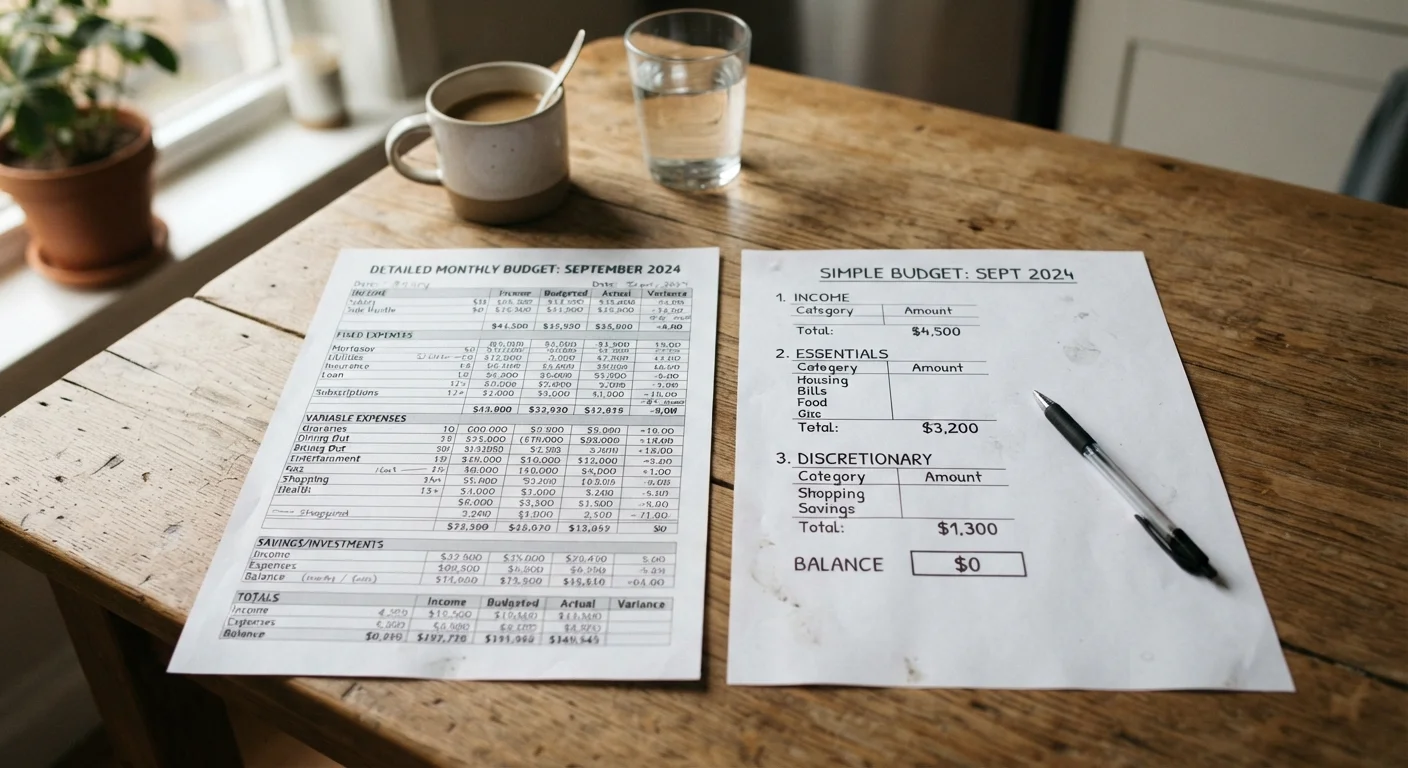
Zero-based budgeting starts from zero at the beginning of each month. You list every expected dollar of income, then assign each dollar to a category: rent, groceries, utilities, insurance, savings, debt payments, and so on. The goal is that income minus all assigned amounts equals exactly zero. Nothing is left unallocated. If a category swells, another must shrink to compensate. This forces a conscious decision about every dollar before it is spent.
The 50/30/20 rule, widely described in personal finance circles and associated with the general framework popularized in All Your Worth by Elizabeth Warren and Amelia Warren Tyagi, divides after-tax income into three percentages: 50% toward needs (housing, food, utilities, transportation), 30% toward wants (dining out, entertainment, subscriptions), and 20% toward savings and debt repayment. The percentages are targets, not strict limits, and the categories are intentionally broad.
See a category-by-category breakdown of where household money goes for help deciding which of your current expenses fall into needs versus wants.
Time and complexity
Zero-based budgeting requires more setup time. A household typically needs to track spending throughout the month, reconcile actual costs against allocations, and rebuild the budget each pay period. For families with irregular expenses, such as school fees, medical costs, or car maintenance, this ongoing reconciliation catches overruns early. However, families that do not track regularly will find the method breaks down quickly.
The 50/30/20 rule asks for much less maintenance. Once a household has a rough sense of its fixed costs, a quick percentage check against monthly take-home pay is often enough to confirm the budget is on track. This lower time cost makes it more likely that a busy family will actually keep using it month after month.
| Zero-based budgeting | 50/30/20 rule | |
|---|---|---|
| Setup time | High: full category list each month | Low: three broad buckets |
| Monthly maintenance | Ongoing: track and reconcile all categories | Minimal: check three percentage targets |
| Spending visibility | Granular: every category visible | Limited: broad buckets can hide detail |
| Flexibility for irregular income | Moderate: rebuilt each month | Moderate: percentages adjust with income |
| Best income type | Variable or tightly constrained | Stable and predictable |
| Risk of abandonment | Higher due to complexity | Lower due to simplicity |
Households with unpredictable income face a separate challenge with both methods. Budgeting strategies for variable-income households require additional adjustments beyond what either framework provides out of the box.
Where each method shows its limits
Zero-based budgeting can be difficult to maintain during chaotic months, such as the back-to-school period or a family health event. Rebuilding an entire budget from scratch every month takes discipline. Some households find the detail level motivating; others find it exhausting enough that they abandon the system after two or three months.
The 50/30/20 rule has a different weakness: the broad categories can hide problems. A household spending 50% on needs may not realize that a specific category, such as food delivery, has quietly grown to an unsustainable size. The rule tells you whether the bucket is overflowing, but not which line item caused it. It also assumes that a 50/30/20 split is appropriate for the household's income level, which may not hold for lower-income families where basic needs already consume more than half of take-home pay.
Both methods share one common limitation: they require honest, complete tracking of income. Without knowing your actual monthly take-home pay and what you actually spend, neither framework produces reliable guidance. For a broader look at building a realistic household structure, see how to build a family budget that holds up month to month.
Pairing either method with other financial priorities
Both frameworks treat savings as a category, but neither answers whether that savings should go toward an emergency fund, debt repayment, or long-term goals. That decision sits outside the budgeting method itself. How families should weigh saving against paying off debt addresses that question directly.
Whichever method a household adopts, an emergency fund is a useful foundation. Without one, an unexpected expense forces families to borrow or reallocate money away from other priorities, which can disrupt either budget structure. What an emergency fund is and how large it should be covers how to think about the right fund size for a household.
This article is general financial information and education, not personalized financial advice. Individual circumstances vary. Consult a qualified financial professional for guidance specific to your situation.