

Key Takeaways
Our Verdict
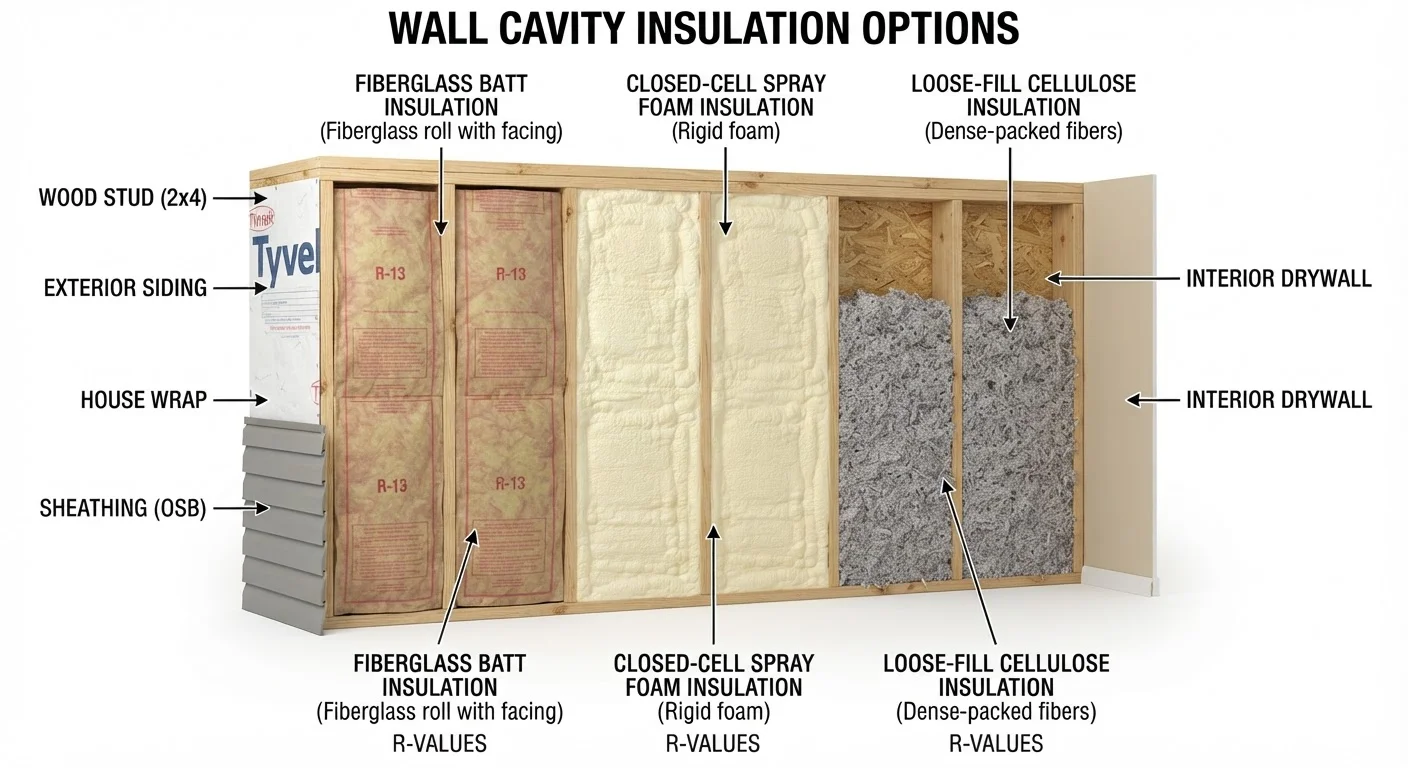
No single insulation type wins in every situation. Fiberglass batts work well for straightforward framed cavities on a tight budget. Spray foam is worth considering where air sealing is the priority, such as rim joists or irregular gaps. Cellulose is a practical middle ground for attics and retrofit walls where coverage consistency matters.
| Best for | Recommended |
|---|---|
| Budget-conscious homeowners insulating standard framed walls or attics | Fiberglass batts |
| Those prioritizing maximum air sealing in hard-to-reach or irregular spaces | Spray foam |
| Retrofit projects or homeowners wanting recycled-content insulation with solid performance | Cellulose |
What R-value actually means
R-value is the standard measure of thermal resistance in insulation. A higher R-value means the material slows heat transfer more effectively per inch of thickness. The U.S. Department of Energy publishes recommended R-values by climate zone; attics in colder northern states typically require R-38 to R-60, while mild southern climates may call for R-30 or less.
R-value alone does not tell the whole story. Air leakage accounts for a large share of heat loss in most homes, and a high-R material that sits loosely in a leaky wall cavity will underperform in real conditions. That gap between rated and actual performance is worth keeping in mind when comparing materials.
Fiberglass: the familiar choice
Fiberglass insulation comes in two main forms: batts (pre-cut blankets sized to fit standard stud spacing) and loose fill (blown into attic floors or wall cavities). Batts are the most common type found in US home improvement stores and are designed for DIY installation in accessible framed spaces.
R-value per inch for fiberglass batts runs roughly 2.9 to 3.8, depending on density. Blown fiberglass achieves similar performance and conforms better to irregular spaces than batts do. Cost is generally the lowest of the three materials covered here, though prices vary by region and product.
The main limitation is air sealing. Fiberglass does not block air movement on its own. Gaps around electrical boxes, pipes, or poorly fitted batts allow conditioned air to escape, reducing effective performance. Proper installation, including cutting batts to fit around obstructions and using a vapor retarder where required by local code, makes a meaningful difference in results.
Check for rebates before you buy
Many utility companies and some state energy offices offer rebates or incentive programs for adding insulation that meets certain R-value thresholds. Check with your utility provider and the Database of State Incentives for Renewables and Efficiency (DSIRE) to see what programs apply in your area before purchasing materials or hiring a contractor.
Spray foam: performance at a cost
Spray polyurethane foam (SPF) comes in two types. Open-cell foam is softer and less expensive, with an R-value around 3.5 to 3.7 per inch. Closed-cell foam is denser, with an R-value of approximately 6 to 7 per inch, and also acts as a vapor barrier. Both types expand to fill gaps and bond to surrounding surfaces, which is what makes spray foam the strongest air-sealing option of the three.
Installation requires professional equipment and proper respiratory protection; this is not a typical DIY project for whole-wall or attic applications, though small cans of one-component foam are sold for sealing specific gaps around pipes and windows. Material and labor costs for professional application are substantially higher than fiberglass or cellulose. Closed-cell foam costs more per square foot than open-cell.
Spray foam works well in rim joists, cathedral ceilings, and other areas where thin profiles, air sealing, and moisture resistance all matter at once. Some building codes restrict spray foam in certain fire-exposure situations without a thermal barrier; check local requirements before specifying it.
| Fiberglass batts | Blown fiberglass | Open-cell spray foam | Closed-cell spray foam | Dense-pack cellulose | |
|---|---|---|---|---|---|
| R-value per inch | 2.9 to 3.8 | 2.9 to 3.8 | 3.5 to 3.7 | 6.0 to 7.0 | 3.2 to 3.8 |
| Air sealing | Minimal | Minimal | Good | Excellent | Moderate |
| Vapor barrier | No | No | No | Yes | No |
| DIY-friendly | Yes | Partial | No | No | No |
| Relative material cost | Low | Low to moderate | Moderate | High | Moderate |
| Retrofit wall use | Difficult | Possible | Possible | Possible | Common |
Cellulose: the recycled-content option
Cellulose insulation is made primarily from recycled newsprint treated with fire retardants, typically boric acid or ammonium sulfate. It is available as loose fill for attics and as dense-pack for retrofit wall cavities. R-value per inch is roughly 3.2 to 3.8, close to fiberglass.
Dense-pack cellulose is blown into closed wall cavities through small holes drilled in the interior or exterior, then patched. This makes it practical for adding insulation to existing walls without removing drywall. The material settles slightly over time, which installers account for by packing it to a higher initial density.
Cellulose manages moisture differently than fiberglass or closed-cell foam. It can absorb and release small amounts of moisture without losing structural integrity, which some builders consider an advantage in climates with variable humidity. However, sustained wetting from a roof or plumbing leak can cause it to clump and lose performance, so addressing any moisture source before installation matters.
Choosing the right fit for your home
For new construction with standard framing and a limited budget, fiberglass batts in walls combined with blown fiberglass or cellulose in the attic is a common and practical approach. The key is careful installation: batts need to fill cavities completely without compression or gaps.
For existing homes where air sealing is a documented problem, spray foam applied at specific leak points (rim joists, attic hatches, top plates) can be combined with less expensive blown insulation in the main attic floor. This hybrid approach targets the highest-impact areas without the cost of whole-house spray foam.
For retrofit walls where adding blown material without full demolition is the goal, dense-pack cellulose is the most practical choice in most cases. Permits and inspections may be required depending on the scope of work and local jurisdiction. Verify requirements with your local building department before starting any insulation project.