

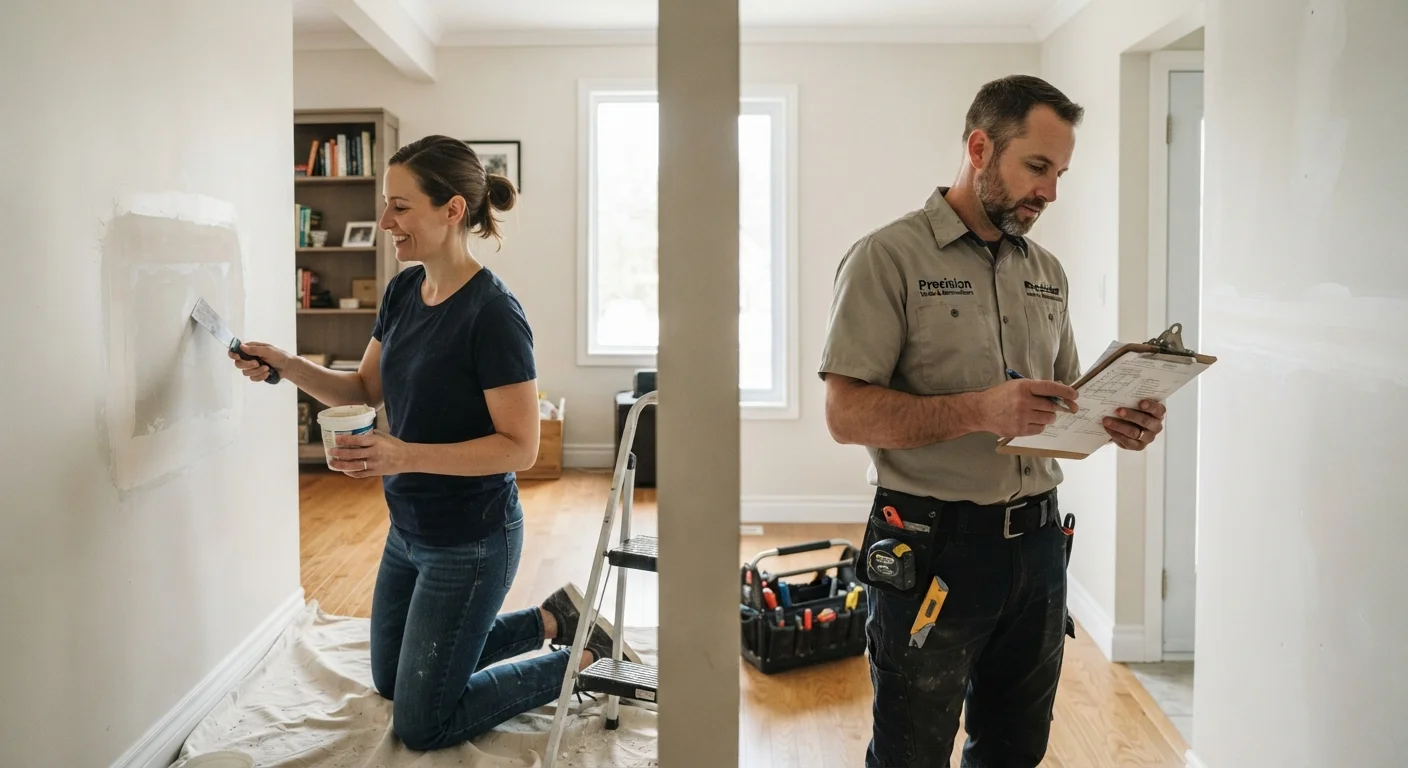
Key Takeaways
Option A
DIY repair
The hands-on, cost-first approach for capable homeowners.
Best for: Homeowners with relevant skills who have time to complete the work safely and correctly.
Option B
Hiring a contractor
The professional route for complex, regulated, or high-stakes work.
Best for: Jobs requiring permits, licensed trades, specialized tools, or work where errors carry serious consequences.
If you want to handle cosmetic or low-risk repairs on a tight budget
DIY repair
Patching drywall, painting, caulking, and basic fixture swaps are well within reach for most homeowners with patience and basic tools. The savings are real and the risks are manageable.
If the repair involves permits, gas lines, or load-bearing structures
Hiring a contractor
Licensed professionals carry liability insurance and know local code requirements. Unpermitted or unsafe work can void homeowner's insurance and complicate future home sales.
If you lack the tools or time to complete the job properly
Hiring a contractor
An incomplete or incorrect repair often costs more to fix than the original problem. A professional can complete the work in a fraction of the time a first-time DIYer might spend.
If you want to build long-term home maintenance skills
DIY repair
Starting with small, forgiving projects builds confidence and a practical skill set that pays off across many future repairs.
What DIY actually costs beyond the materials
The appeal of DIY is straightforward: skip the labor bill and pay only for supplies. For simple jobs, that logic holds. A tube of caulk, a paint roller, or a box of tile grout costs a fraction of what a professional charges per hour. On uncomplicated tasks, the savings are genuine.
Where the math gets complicated is on jobs that require tools you do not own. A tile wet saw, a drywall lift, or a quality oscillating multi-tool can each run $100 or more to rent, or several hundred to buy. If you purchase tools for a single project, the total cost often approaches what a handyman would charge. Factor in a learning curve that produces wasted materials on the first attempt, and the gap narrows further.
Time is the other cost most homeowners undercount. A plumber might clear a stubborn drain in 45 minutes; the same job can take an inexperienced person an afternoon and two trips to a hardware store. If your hourly earnings at work exceed what labor costs for that repair, the financial case for DIY weakens, though that calculation ignores the satisfaction and skill-building that many people value.
| Criterion | DIY repair | Hiring a contractor |
|---|---|---|
| Upfront cost | Materials plus tools | Labor plus materials |
| Time required | Variable, often longer | Typically faster |
| Permit compliance | Homeowner's responsibility | Usually handled by contractor |
| Liability if something goes wrong | Falls on homeowner | Covered by contractor's insurance |
| Skill requirement | Moderate to high for complex jobs | Provided by professional |
| Quality consistency | Depends on experience | Generally predictable |
| Warranty on work | None | Typically included |
When a contractor is worth the premium
Several categories of home repair carry risks that go beyond a botched finish. Electrical work, gas line repairs, and anything that touches a home's structural framing typically require permits in most U.S. jurisdictions. Pulling a permit means an inspector will verify the work meets local building code, which protects your household's safety and preserves your homeowner's insurance coverage.
Unpermitted work is a documented liability. Home inspectors flag it during resale, and insurance companies can deny claims for damage traced to code violations. A contractor who is licensed and insured shifts that liability off your shoulders. Their work is also backed by a warranty in most cases, something a self-done repair cannot provide.
There is also the question of compound damage. A small roof leak addressed incorrectly can allow moisture to reach the sheathing, then the framing, turning a $200 repair into a $2,000 problem. The same pattern appears in plumbing: a DIY fix that holds for six months before failing behind a wall can result in mold remediation costs that dwarf the original repair bill. The principle of deferred maintenance applies here just as it does in personal health: putting off the right fix almost always costs more later.
A practical framework for choosing
Before starting any repair, run through three questions. First, is this work regulated? Check your local building department's website for a permit threshold; many counties list specific job types that require one. If a permit is needed, a licensed contractor is the practical path for most homeowners.
Second, what is the failure mode? Painting a room incorrectly means repainting. Wiring a circuit incorrectly can mean a fire. The higher the consequence of an error, the stronger the case for professional help. Cosmetic work, minor carpentry, and basic fixture swaps fall on the forgiving end of this spectrum.
Third, what does the full DIY cost actually look like? Add up materials, tool rental or purchase, and a realistic estimate of your time. Compare that to two or three contractor quotes, which are free to obtain. The contractor's number is sometimes closer to DIY cost than homeowners expect, particularly for labor-intensive jobs where professionals work much faster.
Families managing household budgets across multiple priorities, including decisions like those covered in balancing savings and debt payoff, often benefit from treating home repairs as a similar prioritization exercise: spend where the risk of not spending is high, and save where the margin for error is wide.
Permits and local codes vary widely
Building permit requirements differ by state, county, and sometimes city. A repair that needs a permit in one jurisdiction may not in another. Always check with your local building department before starting any structural, electrical, or plumbing work. Proceeding without a required permit can result in fines and may require you to undo completed work.